



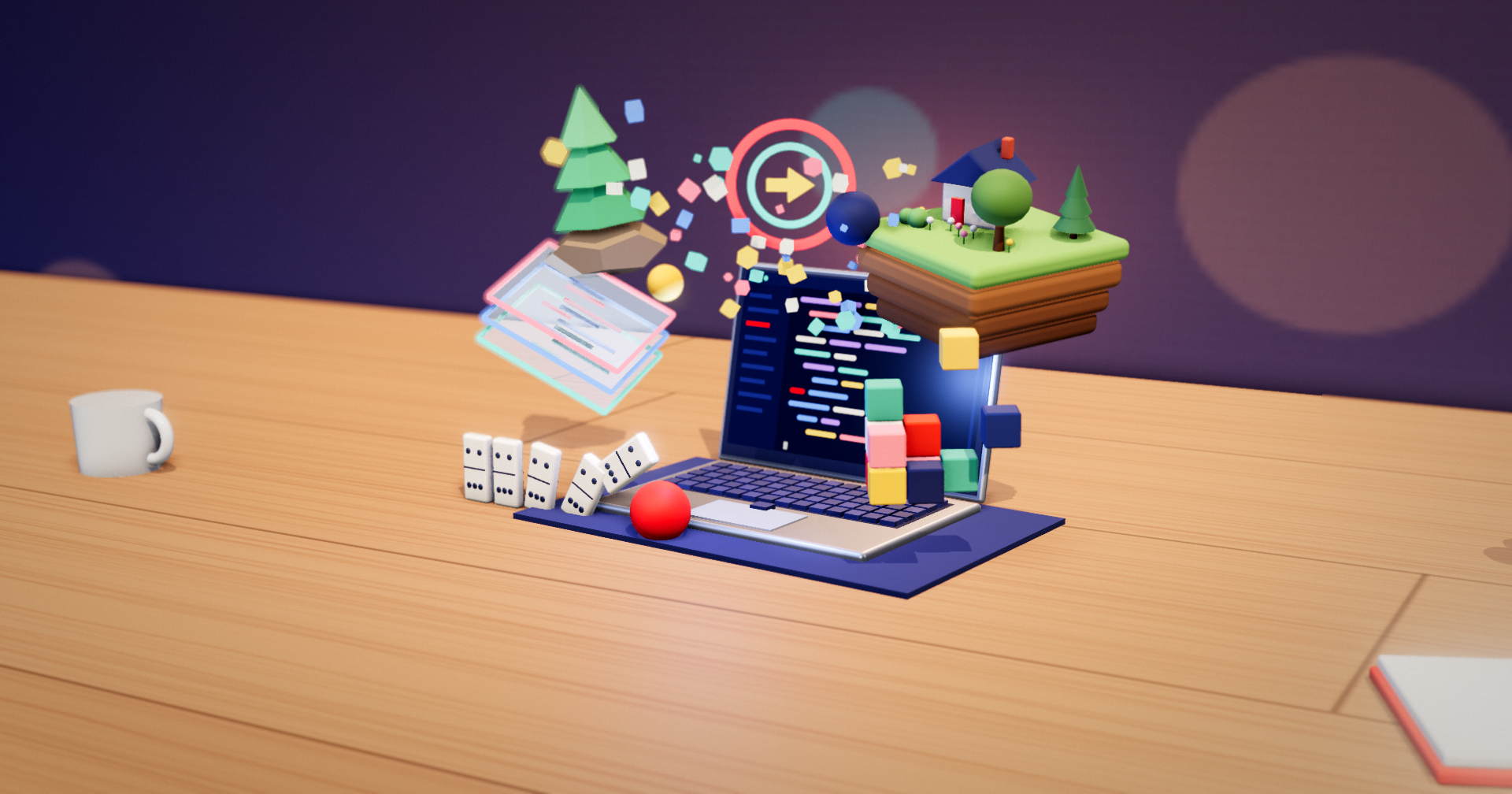
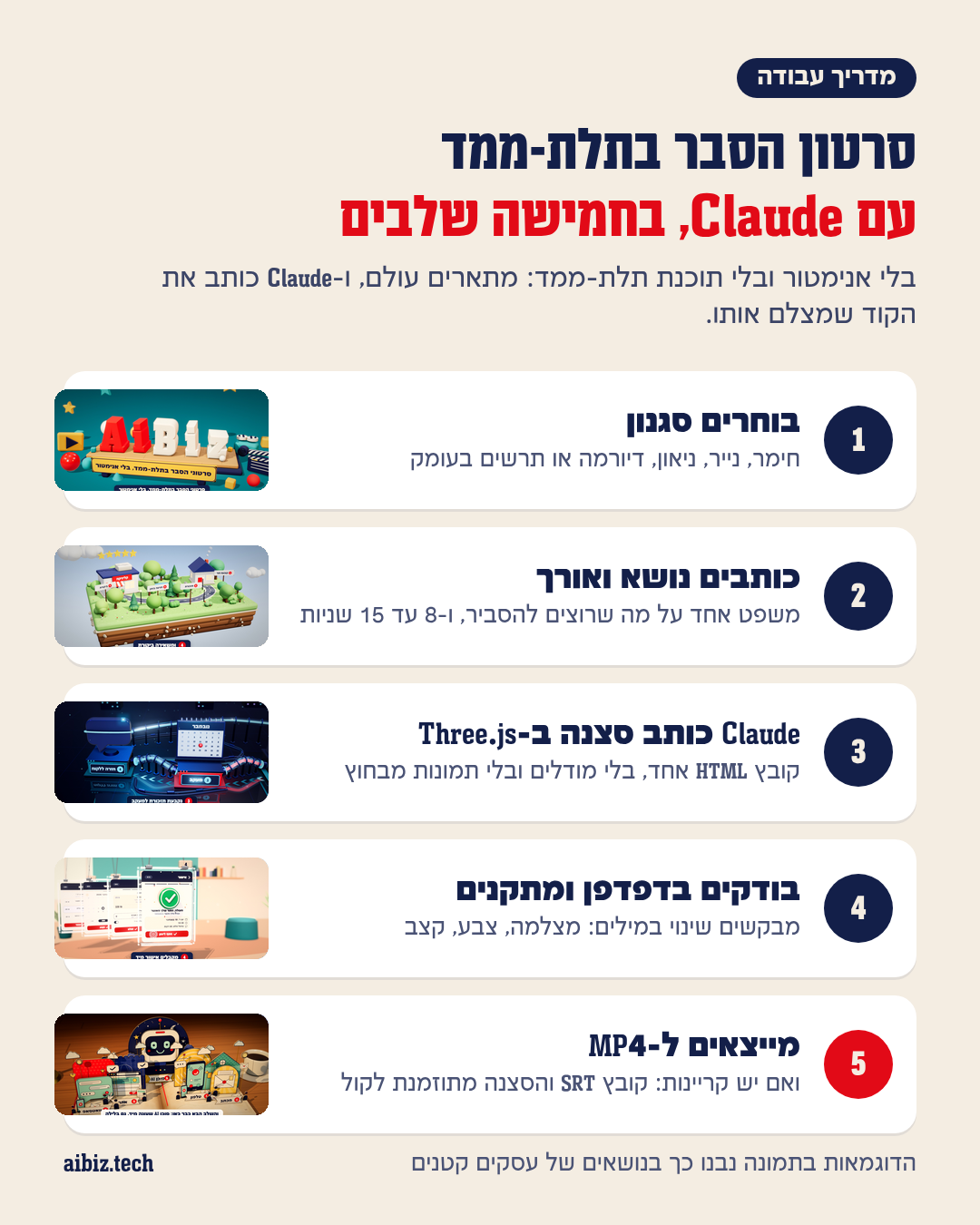
כדי ליצור אנימציית תלת-ממד עם Claude, מבקשים ממנו לכתוב סצנה בספריית Three.js החינמית ומתארים נושא, סגנון ואורך. Claude כותב קובץ HTML אחד שבונה עצמים, אור ומצלמה ומזיז אותם, ואת התוצאה מייצאים מהדפדפן ל-MP4. אפשר להוסיף קריינות מתוזמנת לפי קובץ SRT. כך בנינו את 12 הסרטונים במאמר, לרוחב ולאורך.
ספר פופ-אפ מנייר, עם קריינות בקול של יעקב אברהמוב. תרחיש להמחשה: איך לקוחות פנו לעסקים לאורך השנים.
הרעיון מגיע מהסרטון Claude Makes 3D Animations Easy Now של ערוץ Futurepedia מ-12 בנובמבר 2026, ומ-3D Style Atlas שלהם עם 37 סגנונות. לפי הסרטון, הדוגמה הראשונה לקחה כ-12 דקות. הסרטונים, הנושאים והפרומפטים כאן שלנו, ולא העתקנו את הדוגמאות או את הקוד שלהם.
בקצרה: השיטה מתאימה לסרטון הסבר קצר, לרילס, לשקף פתיחה במצגת או לאנימציה בדף נחיתה. היא לא מחליפה אנימטור בפרויקט גדול, וכל סצנה צריכה בדיקה ותיקונים לפני שהיא נראית טוב.
מה זה בעצם: עולם שמצלמים, לא ציור של כל פריים
בסרטון הקודם של Futurepedia על אנימציה עם Claude הקוד צייר כל פריים מחדש על משטח דו-ממדי, כמו אנימטור שמצייר כל תמונה בנפרד. כדי שקובייה תיראה תלת-ממדית, הקוד היה צריך לזייף את זה: לצייר שלוש פאות שטוחות, להכהות אחת מהן ולצייר צל מתחת.
ב-Three.js הקוד לא מצייר. הוא מתאר עולם: קופסה בגודל מסוים מחימר מט, מנורה, מצלמה עם עדשה. הספרייה מחשבת מה המצלמה הייתה רואה, אילו משטחים תופסים אור, מה בצל ומה לא בפוקוס. כדי להנפיש, הקוד מזיז את העצמים או את המצלמה ומצלם שוב. הצללים, ההשתקפויות והעומק מגיעים מהסצנה עצמה. בסרטון משווים את זה ל-Blender, ומסייגים שזה לא בדיוק אותו דבר.
למה זה מעניין עסק קטן
בעסק של 2 עד 20 עובדים יש הרבה מקומות לסרטון קצר: הסבר על שירות, רילס, שקף פתיחה למצגת, אנימציה לדף נחיתה. בשיטה הזו לא צריך תוכנת תלת-ממד: כותבים תיאור במילים ומקבלים קוד שאפשר לשנות במילים.
יש לזה עוד יתרון: כיוון שהכול קוד, אפשר לקחת סגנון אחד ולהשתמש בו לכמה סרטונים, כך שכל הסדרה נראית אחידה. בסרטון מראים בדיוק את זה, אותו סגנון low-poly לשני נושאים שונים.
איך עושים את זה, שלב אחר שלב
- מתחילים מפרומפט פשוט. בסרטון הפרומפט נשמע בערך כך: Use Three.js to make a 15 second animated explainer on how closed loop cooling works in a data center. כלומר: להשתמש ב-Three.js, אורך, ונושא.
- מחכים לקוד. Claude כותב את הסצנה, מציב אור ומצלמה ומנפיש. בדוגמה של הסרטון זה לקח כ-12 דקות, עם מודל Fable ברמת מאמץ גבוהה.
- מוסיפים סגנון. בלי הנחיות עיצוב, התוצאה בלי סגנון ייחודי. מתארים חומר, צבעים, תאורה ותנועת מצלמה, או מתחילים מסגנון מוכן.
- מבקשים סאונד אם צריך. לפי הסרטון, Claude יוסיף אפקטים קוליים אם מבקשים, וזה מאריך מעט את זמן היצירה.
- מתקנים במילים. כיוון שהכול קוד, קל לבקש שינוי במה שקורה בסצנה, לתקן שגיאה או לשנות סגנון.
- מייצאים לסרטון. את הסרטונים שלנו ייצאנו פריים אחרי פריים מדפדפן Chrome אוטומטי ל-MP4 ברזולוציית 1920 על 1080, וגם בגרסה אנכית 1080 על 1920.
12 הסגנונות שבנינו, עם הפרומפט של כל אחד
Futurepedia בנו אטלס של 37 סגנונות, מחולקים לשבע משפחות. בחרנו 12 סגנונות שמכסים את כל שבע המשפחות, ובנינו לכל אחד סרטון משלנו בנושא של עסק קטן. כל הנושאים הם תרחיש להמחשה, לא סיפור של לקוח אמיתי.
שקיפות: את קוד 12 הסצנות בסרטוני הדוגמה כתבו מודלים של Claude: ברוב הסצנות Claude Sonnet לפי הסקיל שלנו ל-Three.js, בסצנת הדיורמה Claude Fable 5.2, ובסצנות מגדלי הנתונים והבנייה מקוביות שניהם יחד, כמפורט מתחת לכל סרטון. הייצוא ל-MP4 נעשה ב-Chrome אוטומטי, ב-1080p. לכל סגנון יש גרסה לרוחב וגרסה אנכית לרילס, שבה החלק התחתון נשאר נקי לפרזנטור או לאווטאר. הפרומפט שמופיע מתחת לכל סרטון הוא הפרומפט שבאמת הפיק את הסצנה הזו, ואפשר להדביק אותו ב-Claude. התוצאה אצלכם לא תהיה זהה לשלנו, כי כל הרצה כותבת קוד אחר.
| # | סגנון | משפחה | סוג | אורך | מתאים ל |
|---|---|---|---|---|---|
| 01 | אי low-poly | מראה מעובד | הסבר | 12 שניות | הסבר על תהליך או שירות |
| 02 | ספר פופ-אפ מנייר | עולמות מחומר | סיפור | 14.6 שניות | סיפור עם התחלה וסוף, טוב עם קריינות |
| 03 | שלט ניאון | שטוח שקם לחיים | הסבר | 11 שניות | הסבר על תהליך או שירות |
| 04 | דיורמה מרחפת | מקומות ומסלולים | הסבר | 12 שניות | הסבר על תהליך או שירות |
| 05 | צינור זוהר | תרשימים בעומק | הסבר | 12 שניות | הסבר על תהליך או שירות |
| 06 | כותרת מחימר | עולמות מחומר | כותרת | 8 שניות | פתיח, סגיר או הודעה קצרה |
| 07 | שרשרת דומינו | מנגנונים שמספרים | הסבר | 11 שניות | הסבר על תהליך או שירות |
| 08 | מגדלי נתונים | תרשימים בעומק | הסבר | 10 שניות | הסבר על תהליך או שירות |
| 09 | מסכים מרחפים | מוצר ומסך | שוט מוצר | 10 שניות | הצגת אפליקציה, טופס או מוצר דיגיטלי |
| 10 | בנייה מקוביות | מראה מעובד | סיפור | 11 שניות | סיפור עם התחלה וסוף, טוב עם קריינות |
| 11 | ערימת שכבות זכוכית | תרשימים בעומק | הסבר | 11 שניות | הסבר על תהליך או שירות |
| 12 | לוח תצוגה מתהפך | שטוח שקם לחיים | כותרת | 9 שניות | פתיח, סגיר או הודעה קצרה |
אי low-poly
אי קטן בסגנון פוליגונים שטוחים: עץ צומח שלב אחר שלב, ושלטי עץ ממוספרים מסמנים כל שלב בתהליך. מתאים להסבר על צמיחה הדרגתית.
תרחיש להמחשה: איך תוכן קבוע מצמיח עסק קטן: מפרסמים תוכן בקביעות, הקהל מתחיל להכיר את העסק, מגיעות פניות, הפניות הופכות למכירות.
קוד הסצנה נכתב ב-Claude Sonnet, לפי הסקיל שלנו ל-Three.js.
הצגת הפרומפט המלא
You are a senior three.js motion designer. Build ONE self-contained HTML file that renders a 12-second 3D animation at 1920x1080 (16:9).

TOPIC: איך תוכן קבוע מצמיח עסק קטן: מפרסמים תוכן בקביעות, הקהל מתחיל להכיר את העסק, מגיעות פניות, הפניות הופכות למכירות.
Audience: owners of small businesses (2 to 20 employees). Show the idea, not a lecture.

RENDERING RULES
- three.js from a CDN import map (three + three/addons). No external models, textures or images: build every object from geometry, materials and canvas textures.
- Deterministic timeline: expose window.renderAt(t) that sets every object for time t (seconds) and renders one frame. No Math.random() at render time (use a seeded RNG), no clock-based motion.
- Add a small "Export MP4" button: step t from 0 to 12 at 30 fps, capture each frame (canvas.toBlob or MediaRecorder on a fixed-step loop) and give me a download. Also tell me how to render it with Puppeteer + ffmpeg if the browser export is slow.
- ACES tone mapping, sRGB output, soft shadows, antialiasing (render the composer into a multisampled target), devicePixelRatio 1 during export.
- 3 to 5 beats. Each beat gets a short on-screen caption (max 6 words) in a rounded pill at the bottom, with a small numbered circle. Captions are HTML over the canvas, in the language of the topic (Hebrew = RTL, font-family "Heebo" or the brand font I give you).
- Palette: follow the STYLE block below. If I give brand colours, use my accent colour once per beat, for the thing that matters.
- Camera: one continuous move with easing (no cuts), keep every label inside the frame, leave 8% safe margins.

STYLE: Low-poly island at golden hour
- Everything faceted (flatShading), neighbouring facets a shade apart. No smooth spheres.
- A faceted island rising from a faceted teal sea, layered faceted mountain ranges behind in atmospheric haze, sunset sky gradient from peach to soft violet, low-poly clouds and birds.
- Low warm sun from the side with long shadows, cool violet fill.
- Palette: sand, coral, teal, deep green, cream. The accent red is only for the thing the story is about.
- At least 25 faceted trees, rocks, bushes, a small house with details, a jetty and a boat. The hero object grows beat by beat.
- Labels: numbered wooden signposts that pop in one per beat. Camera: one eased orbit of about 35 degrees with a slight push in.

LOOK (this is what separates a designed scene from a flat sample, do all of it)
- Image-based light from a procedural RoomEnvironment (PMREM) at low intensity plus a 3-point rig: warm key with soft shadows (4096 map), coloured fill from the opposite side, rim from behind, very low ambient. Shadows must be clearly visible on the ground.
- Post-processing with EffectComposer: ambient occlusion (GTAOPass), depth of field (BokehPass) with the focus on the subject, mild bloom (UnrealBloomPass, threshold above 1 for bright scenes), then OutputPass and a final grade pass (vignette, light film grain, contrast about 1.1, saturation about 1.15).
- Named material finishes instead of the default plastic: matte clay (MeshPhysicalMaterial with low sheen), gloss (clearcoat), brushed metal, acrylic glass, paper. Big surfaces get a procedural canvas bump texture (grain, wood, brick). No image files.
- Density: at least 60 objects. Scatter with a seeded RNG, cluster them, vary scale and jitter the colour of every instance, keep paths and labels clear. Add the small things (frames, knobs, lamps, pebbles, lit windows).
- Depth layers: something soft in the foreground, the subject, something behind it.
- Labels are objects inside the scene (signposts, plaques, printed cards) that take light and shadow, never a flat overlay. Keep them out of the bottom 18% of the frame where the caption sits.
- Motion: staggered entrances with overshoot, constant small secondary motion (hover, sway, smoke, blinking lights), one continuous eased camera move that follows the story.
- Before you finish, render 4 frames (12%, 40%, 68%, 95% of the clip), look at them, and fix: anything cropped, anything milky or flat, any unreadable label.

Before you write code, list the beats with start and end times. Then output the full file.
ספר פופ-אפ מנייר
ספר פתוח על שולחן, ובכל עמוד קם פופ-אפ מנייר. עובד הכי טוב עם קריינות: כל משפט מקים את הפריט הבא.
תרחיש להמחשה: איך לקוחות פונים לעסק: פעם מכתב, אחר כך טלפון, אחר כך טופס באתר, היום וואטסאפ, והשלב הבא: סוכן AI שעונה מיד, גם באמצע הלילה.
קוד הסצנה נכתב ב-Claude Sonnet, לפי הסקיל שלנו ל-Three.js.
הצגת הפרומפט המלא
You are a senior three.js motion designer. Build ONE self-contained HTML file that renders a 14.6-second 3D animation at 1920x1080 (16:9).

TOPIC: איך לקוחות פונים לעסק: פעם מכתב, אחר כך טלפון, אחר כך טופס באתר, היום וואטסאפ, והשלב הבא: סוכן AI שעונה מיד, גם באמצע הלילה.
Audience: owners of small businesses (2 to 20 employees). Show the idea, not a lecture.

RENDERING RULES
- three.js from a CDN import map (three + three/addons). No external models, textures or images: build every object from geometry, materials and canvas textures.
- Deterministic timeline: expose window.renderAt(t) that sets every object for time t (seconds) and renders one frame. No Math.random() at render time (use a seeded RNG), no clock-based motion.
- Add a small "Export MP4" button: step t from 0 to 14.6 at 30 fps, capture each frame (canvas.toBlob or MediaRecorder on a fixed-step loop) and give me a download. Also tell me how to render it with Puppeteer + ffmpeg if the browser export is slow.
- ACES tone mapping, sRGB output, soft shadows, antialiasing (render the composer into a multisampled target), devicePixelRatio 1 during export.
- 3 to 5 beats. Each beat gets a short on-screen caption (max 6 words) in a rounded pill at the bottom, with a small numbered circle. Captions are HTML over the canvas, in the language of the topic (Hebrew = RTL, font-family "Heebo" or the brand font I give you).
- Palette: follow the STYLE block below. If I give brand colours, use my accent colour once per beat, for the thing that matters.
- Camera: one continuous move with easing (no cuts), keep every label inside the frame, leave 8% safe margins.

STYLE: Pop-up book on a desk
- An open book lies on a warm wooden desk in evening lamplight. Every story element is a flat die-cut card that unfolds up from the page on a hinge with overshoot, standing in 3 or 4 depth layers.
- Thick page edges, a centre crease, a cloth spine. Around the book, out of focus: a pencil, a coffee cup, paper clips, a lamp base.
- Paper card with grain, printed flat colours with a darker printed outline, cream reverse sides. The shadows of each card layer on the layer behind it are the main depth cue.
- One warm lamp key from the upper left, dim cool fill, dark vignette.
- Palette: cream paper, navy ink, one red accent, mustard, soft teal.
- Each beat: one main pop-up plus 6 to 10 small paper details (clouds on wires, envelopes, little people, stars). Labels are printed paper banners and page tabs.
- Camera: low three-quarter view over the desk, shallow depth of field, slow push and drift. If there is a voice-over, every pop-up lands exactly on its SRT cue.

LOOK (this is what separates a designed scene from a flat sample, do all of it)
- Image-based light from a procedural RoomEnvironment (PMREM) at low intensity plus a 3-point rig: warm key with soft shadows (4096 map), coloured fill from the opposite side, rim from behind, very low ambient. Shadows must be clearly visible on the ground.
- Post-processing with EffectComposer: ambient occlusion (GTAOPass), depth of field (BokehPass) with the focus on the subject, mild bloom (UnrealBloomPass, threshold above 1 for bright scenes), then OutputPass and a final grade pass (vignette, light film grain, contrast about 1.1, saturation about 1.15).
- Named material finishes instead of the default plastic: matte clay (MeshPhysicalMaterial with low sheen), gloss (clearcoat), brushed metal, acrylic glass, paper. Big surfaces get a procedural canvas bump texture (grain, wood, brick). No image files.
- Density: at least 60 objects. Scatter with a seeded RNG, cluster them, vary scale and jitter the colour of every instance, keep paths and labels clear. Add the small things (frames, knobs, lamps, pebbles, lit windows).
- Depth layers: something soft in the foreground, the subject, something behind it.
- Labels are objects inside the scene (signposts, plaques, printed cards) that take light and shadow, never a flat overlay. Keep them out of the bottom 18% of the frame where the caption sits.
- Motion: staggered entrances with overshoot, constant small secondary motion (hover, sway, smoke, blinking lights), one continuous eased camera move that follows the story.
- Before you finish, render 4 frames (12%, 40%, 68%, 95% of the clip), look at them, and fix: anything cropped, anything milky or flat, any unreadable label.

Before you write code, list the beats with start and end times. Then output the full file.
שלט ניאון
אייקונים שטוחים הופכים לצינורות ניאון זוהרים על קיר לבנים כהה ונדלקים לפי הסדר. טוב לתהליך של שלושה עד חמישה שלבים.
תרחיש להמחשה: משיחת טלפון לעסקה סגורה: הטלפון מצלצל, ממשיכים בשיחה בוואטסאפ, נקבעת פגישה, נסגרת עסקה.
קוד הסצנה נכתב ב-Claude Sonnet, לפי הסקיל שלנו ל-Three.js.
הצגת הפרומפט המלא
You are a senior three.js motion designer. Build ONE self-contained HTML file that renders a 11-second 3D animation at 1920x1080 (16:9).

TOPIC: משיחת טלפון לעסקה סגורה: הטלפון מצלצל, ממשיכים בשיחה בוואטסאפ, נקבעת פגישה, נסגרת עסקה.
Audience: owners of small businesses (2 to 20 employees). Show the idea, not a lecture.

RENDERING RULES
- three.js from a CDN import map (three + three/addons). No external models, textures or images: build every object from geometry, materials and canvas textures.
- Deterministic timeline: expose window.renderAt(t) that sets every object for time t (seconds) and renders one frame. No Math.random() at render time (use a seeded RNG), no clock-based motion.
- Add a small "Export MP4" button: step t from 0 to 11 at 30 fps, capture each frame (canvas.toBlob or MediaRecorder on a fixed-step loop) and give me a download. Also tell me how to render it with Puppeteer + ffmpeg if the browser export is slow.
- ACES tone mapping, sRGB output, soft shadows, antialiasing (render the composer into a multisampled target), devicePixelRatio 1 during export.
- 3 to 5 beats. Each beat gets a short on-screen caption (max 6 words) in a rounded pill at the bottom, with a small numbered circle. Captions are HTML over the canvas, in the language of the topic (Hebrew = RTL, font-family "Heebo" or the brand font I give you).
- Palette: follow the STYLE block below. If I give brand colours, use my accent colour once per beat, for the thing that matters.
- Camera: one continuous move with easing (no cuts), keep every label inside the frame, leave 8% safe margins.

STYLE: Neon sign on a brick wall at night
- Icons and arrows are bent glass tubes (TubeGeometry along curves, emissive) that strike on in story order with a flicker. Each tube sits on small metal standoffs with a dark cable running to a transformer box. Unlit tubes look like grey glass.
- A dark painted brick wall with visible mortar relief (procedural brick texture with bump) and a wet dark floor that picks up the glow as soft colour pools.
- Almost no ambient light: the neon is the light. A coloured point light at every lit tube tints the bricks around it.
- Palette: warm red-pink, cool cyan, warm amber for the final result, on near-black blue.
- Labels: small enamel plaques mounted under each icon, numbered, lit by the neon.
- Bloom strength .7 to 1.0 with threshold about .9, plaques kept below 1.0 so the text stays readable, strong vignette.
- Camera: slow lateral track with a small yaw so the tubes show parallax against the wall.

LOOK (this is what separates a designed scene from a flat sample, do all of it)
- Image-based light from a procedural RoomEnvironment (PMREM) at low intensity plus a 3-point rig: warm key with soft shadows (4096 map), coloured fill from the opposite side, rim from behind, very low ambient. Shadows must be clearly visible on the ground.
- Post-processing with EffectComposer: ambient occlusion (GTAOPass), depth of field (BokehPass) with the focus on the subject, mild bloom (UnrealBloomPass, threshold above 1 for bright scenes), then OutputPass and a final grade pass (vignette, light film grain, contrast about 1.1, saturation about 1.15).
- Named material finishes instead of the default plastic: matte clay (MeshPhysicalMaterial with low sheen), gloss (clearcoat), brushed metal, acrylic glass, paper. Big surfaces get a procedural canvas bump texture (grain, wood, brick). No image files.
- Density: at least 60 objects. Scatter with a seeded RNG, cluster them, vary scale and jitter the colour of every instance, keep paths and labels clear. Add the small things (frames, knobs, lamps, pebbles, lit windows).
- Depth layers: something soft in the foreground, the subject, something behind it.
- Labels are objects inside the scene (signposts, plaques, printed cards) that take light and shadow, never a flat overlay. Keep them out of the bottom 18% of the frame where the caption sits.
- Motion: staggered entrances with overshoot, constant small secondary motion (hover, sway, smoke, blinking lights), one continuous eased camera move that follows the story.
- Before you finish, render 4 frames (12%, 40%, 68%, 95% of the clip), look at them, and fix: anything cropped, anything milky or flat, any unreadable label.

Before you write code, list the beats with start and end times. Then output the full file.
דיורמה מרחפת
עולם קטן על משטח מרחף: דמות קטנה עוברת בין תחנות בדרך. מתאים לתהליך שלקוח עובר מההתחלה עד הסוף.
תרחיש להמחשה: זימון תורים אונליין בקליניקה: הלקוחה קובעת תור אונליין, מקבלת תזכורת אוטומטית יום לפני, מגיעה בזמן, ומשאירה ביקורת.
קוד הסצנה נכתב ב-Claude Fable 5.2.
הצגת הפרומפט המלא
You are a senior three.js motion designer. Build ONE self-contained HTML file that renders a 12-second 3D animation at 1920x1080 (16:9).

TOPIC: זימון תורים אונליין בקליניקה: הלקוחה קובעת תור אונליין, מקבלת תזכורת אוטומטית יום לפני, מגיעה בזמן, ומשאירה ביקורת.
Audience: owners of small businesses (2 to 20 employees). Show the idea, not a lecture.

RENDERING RULES
- three.js from a CDN import map (three + three/addons). No external models, textures or images: build every object from geometry, materials and canvas textures.
- Deterministic timeline: expose window.renderAt(t) that sets every object for time t (seconds) and renders one frame. No Math.random() at render time (use a seeded RNG), no clock-based motion.
- Add a small "Export MP4" button: step t from 0 to 12 at 30 fps, capture each frame (canvas.toBlob or MediaRecorder on a fixed-step loop) and give me a download. Also tell me how to render it with Puppeteer + ffmpeg if the browser export is slow.
- ACES tone mapping, sRGB output, soft shadows, antialiasing (render the composer into a multisampled target), devicePixelRatio 1 during export.
- 3 to 5 beats. Each beat gets a short on-screen caption (max 6 words) in a rounded pill at the bottom, with a small numbered circle. Captions are HTML over the canvas, in the language of the topic (Hebrew = RTL, font-family "Heebo" or the brand font I give you).
- Palette: follow the STYLE block below. If I give brand colours, use my accent colour once per beat, for the thing that matters.
- Camera: one continuous move with easing (no cuts), keep every label inside the frame, leave 8% safe margins.

STYLE: Tiny floating diorama
- A floating tile like a model-maker's display: speckled grass top, three soil strata on the sides with pebbles, against a sky-blue studio gradient with puffy clouds at two depths.
- Chunky rounded buildings in matte clay with details: gable roof, chimney with smoke puffs, lit windows with frames, door with a brass knob, striped awning, planters.
- A curved road with a dashed centre line, a pond with lily pads, 30 lollipop trees and pines, bushes, 70 tiny flowers, street lamps, a bench, a picket fence.
- A tiny peg character walks the road with a bobbing step. Floating objects (a phone with a real drawn screen, a message card with a bell, gold stars) pop in at each station and face the camera.
- Warm key, cool fill, long soft shadows. Tilt-shift: narrow FOV (about 22), high three-quarter camera, subtle depth of field.
- Labels: numbered signposts that pop in per beat. Camera: slow drift that follows the character, slight push in.

LOOK (this is what separates a designed scene from a flat sample, do all of it)
- Image-based light from a procedural RoomEnvironment (PMREM) at low intensity plus a 3-point rig: warm key with soft shadows (4096 map), coloured fill from the opposite side, rim from behind, very low ambient. Shadows must be clearly visible on the ground.
- Post-processing with EffectComposer: ambient occlusion (GTAOPass), depth of field (BokehPass) with the focus on the subject, mild bloom (UnrealBloomPass, threshold above 1 for bright scenes), then OutputPass and a final grade pass (vignette, light film grain, contrast about 1.1, saturation about 1.15).
- Named material finishes instead of the default plastic: matte clay (MeshPhysicalMaterial with low sheen), gloss (clearcoat), brushed metal, acrylic glass, paper. Big surfaces get a procedural canvas bump texture (grain, wood, brick). No image files.
- Density: at least 60 objects. Scatter with a seeded RNG, cluster them, vary scale and jitter the colour of every instance, keep paths and labels clear. Add the small things (frames, knobs, lamps, pebbles, lit windows).
- Depth layers: something soft in the foreground, the subject, something behind it.
- Labels are objects inside the scene (signposts, plaques, printed cards) that take light and shadow, never a flat overlay. Keep them out of the bottom 18% of the frame where the caption sits.
- Motion: staggered entrances with overshoot, constant small secondary motion (hover, sway, smoke, blinking lights), one continuous eased camera move that follows the story.
- Before you finish, render 4 frames (12%, 40%, 68%, 95% of the clip), look at them, and fix: anything cropped, anything milky or flat, any unreadable label.

Before you write code, list the beats with start and end times. Then output the full file.
צינור זוהר
תרשים זרימה בחלל כהה: חבילות אור עוברות בצינור בין תחנות. טוב לאוטומציות ולזרימת מידע.
תרחיש להמחשה: ליד מוואטסאפ שנשמר לבד: הודעה נכנסת בוואטסאפ, הליד נשמר ב-CRM, נקבעת תזכורת למעקב, והלולאה נסגרת כשחוזרים ללקוח.
קוד הסצנה נכתב ב-Claude Sonnet, לפי הסקיל שלנו ל-Three.js.
הצגת הפרומפט המלא
You are a senior three.js motion designer. Build ONE self-contained HTML file that renders a 12-second 3D animation at 1920x1080 (16:9).

TOPIC: ליד מוואטסאפ שנשמר לבד: הודעה נכנסת בוואטסאפ, הליד נשמר ב-CRM, נקבעת תזכורת למעקב, והלולאה נסגרת כשחוזרים ללקוח.
Audience: owners of small businesses (2 to 20 employees). Show the idea, not a lecture.

RENDERING RULES
- three.js from a CDN import map (three + three/addons). No external models, textures or images: build every object from geometry, materials and canvas textures.
- Deterministic timeline: expose window.renderAt(t) that sets every object for time t (seconds) and renders one frame. No Math.random() at render time (use a seeded RNG), no clock-based motion.
- Add a small "Export MP4" button: step t from 0 to 12 at 30 fps, capture each frame (canvas.toBlob or MediaRecorder on a fixed-step loop) and give me a download. Also tell me how to render it with Puppeteer + ffmpeg if the browser export is slow.
- ACES tone mapping, sRGB output, soft shadows, antialiasing (render the composer into a multisampled target), devicePixelRatio 1 during export.
- 3 to 5 beats. Each beat gets a short on-screen caption (max 6 words) in a rounded pill at the bottom, with a small numbered circle. Captions are HTML over the canvas, in the language of the topic (Hebrew = RTL, font-family "Heebo" or the brand font I give you).
- Palette: follow the STYLE block below. If I give brand colours, use my accent colour once per beat, for the thing that matters.
- Camera: one continuous move with easing (no cuts), keep every label inside the frame, leave 8% safe margins.

STYLE: Glowing pipeline machine
- A process diagram built as a physical machine: every station is a real object on a machined pedestal (a phone with a drawn chat, a small server rack with blinking LEDs, a desk calendar with a pin, a speech-bubble beacon), joined by glass tubes through which glowing pulses travel.
- A dark glossy stage floor that reflects the glow (mirrored copies of the objects under a semi-transparent floor), fading into a deep blue-violet backdrop with haze, dim city-like light panels far behind.
- Glass tubes with brackets, brushed dark metal, satin plastic, screens with real drawn UI kept below bloom level so they stay readable.
- Dim cool ambient, soft top key, coloured lights that switch on at each station when its beat starts.
- Palette: deep navy, cyan glow, one red for the pulse and the active station, white UI.
- Labels: backlit numbered plaques on each pedestal. Bloom about .7 at threshold .9.
- Camera: one eased dolly that follows the pulse from the first station to the last, ending wider.

LOOK (this is what separates a designed scene from a flat sample, do all of it)
- Image-based light from a procedural RoomEnvironment (PMREM) at low intensity plus a 3-point rig: warm key with soft shadows (4096 map), coloured fill from the opposite side, rim from behind, very low ambient. Shadows must be clearly visible on the ground.
- Post-processing with EffectComposer: ambient occlusion (GTAOPass), depth of field (BokehPass) with the focus on the subject, mild bloom (UnrealBloomPass, threshold above 1 for bright scenes), then OutputPass and a final grade pass (vignette, light film grain, contrast about 1.1, saturation about 1.15).
- Named material finishes instead of the default plastic: matte clay (MeshPhysicalMaterial with low sheen), gloss (clearcoat), brushed metal, acrylic glass, paper. Big surfaces get a procedural canvas bump texture (grain, wood, brick). No image files.
- Density: at least 60 objects. Scatter with a seeded RNG, cluster them, vary scale and jitter the colour of every instance, keep paths and labels clear. Add the small things (frames, knobs, lamps, pebbles, lit windows).
- Depth layers: something soft in the foreground, the subject, something behind it.
- Labels are objects inside the scene (signposts, plaques, printed cards) that take light and shadow, never a flat overlay. Keep them out of the bottom 18% of the frame where the caption sits.
- Motion: staggered entrances with overshoot, constant small secondary motion (hover, sway, smoke, blinking lights), one continuous eased camera move that follows the story.
- Before you finish, render 4 frames (12%, 40%, 68%, 95% of the clip), look at them, and fix: anything cropped, anything milky or flat, any unreadable label.

Before you write code, list the beats with start and end times. Then output the full file.
כותרת מחימר
מילה גדולה בתלת-ממד, עשויה כמו פלסטלינה, נוחתת על בסיס ומקפצת קלות. פתיח או סגיר לסרטון.
תרחיש להמחשה: כותרת פתיחה: השם AiBiz, וכתובית: סרטוני הסבר בתלת-ממד, בלי אנימטור.
קוד הסצנה נכתב ב-Claude Sonnet, לפי הסקיל שלנו ל-Three.js.
הצגת הפרומפט המלא
You are a senior three.js motion designer. Build ONE self-contained HTML file that renders a 8-second 3D animation at 1920x1080 (16:9).

TOPIC: כותרת פתיחה: השם AiBiz, וכתובית: סרטוני הסבר בתלת-ממד, בלי אנימטור.
Audience: owners of small businesses (2 to 20 employees). Show the idea, not a lecture.

RENDERING RULES
- three.js from a CDN import map (three + three/addons). No external models, textures or images: build every object from geometry, materials and canvas textures.
- Deterministic timeline: expose window.renderAt(t) that sets every object for time t (seconds) and renders one frame. No Math.random() at render time (use a seeded RNG), no clock-based motion.
- Add a small "Export MP4" button: step t from 0 to 8 at 30 fps, capture each frame (canvas.toBlob or MediaRecorder on a fixed-step loop) and give me a download. Also tell me how to render it with Puppeteer + ffmpeg if the browser export is slow.
- ACES tone mapping, sRGB output, soft shadows, antialiasing (render the composer into a multisampled target), devicePixelRatio 1 during export.
- 3 to 5 beats. Each beat gets a short on-screen caption (max 6 words) in a rounded pill at the bottom, with a small numbered circle. Captions are HTML over the canvas, in the language of the topic (Hebrew = RTL, font-family "Heebo" or the brand font I give you).
- Palette: follow the STYLE block below. If I give brand colours, use my accent colour once per beat, for the thing that matters.
- Camera: one continuous move with easing (no cuts), keep every label inside the frame, leave 8% safe margins.

STYLE: Claymation title
- The title is chunky hand-made clay letters: extruded text with a large bevel, depth about half the letter height, a grain bump so they show dents, each letter with its own small tilt. Letters drop in one by one with squash and stretch.
- A seamless saturated paper sweep (deep teal or mustard, never beige) with a soft contact shadow, a wooden base strip under the title.
- 15 or more clay props that tell what the series is about (a play button, a clapper, a camera, stars, a pencil, cubes and spheres), some blurred in the foreground.
- Big soft key from the upper left, warm bounce.
- Palette: one red, cream, navy, plus two toy colours.
- The subtitle is a plaque standing in front of the base. Secondary wobble quantised to 12 steps per second for a stop-motion feel.
- Camera: slow eased orbit of about 25 degrees, noticeable depth of field.

LOOK (this is what separates a designed scene from a flat sample, do all of it)
- Image-based light from a procedural RoomEnvironment (PMREM) at low intensity plus a 3-point rig: warm key with soft shadows (4096 map), coloured fill from the opposite side, rim from behind, very low ambient. Shadows must be clearly visible on the ground.
- Post-processing with EffectComposer: ambient occlusion (GTAOPass), depth of field (BokehPass) with the focus on the subject, mild bloom (UnrealBloomPass, threshold above 1 for bright scenes), then OutputPass and a final grade pass (vignette, light film grain, contrast about 1.1, saturation about 1.15).
- Named material finishes instead of the default plastic: matte clay (MeshPhysicalMaterial with low sheen), gloss (clearcoat), brushed metal, acrylic glass, paper. Big surfaces get a procedural canvas bump texture (grain, wood, brick). No image files.
- Density: at least 60 objects. Scatter with a seeded RNG, cluster them, vary scale and jitter the colour of every instance, keep paths and labels clear. Add the small things (frames, knobs, lamps, pebbles, lit windows).
- Depth layers: something soft in the foreground, the subject, something behind it.
- Labels are objects inside the scene (signposts, plaques, printed cards) that take light and shadow, never a flat overlay. Keep them out of the bottom 18% of the frame where the caption sits.
- Motion: staggered entrances with overshoot, constant small secondary motion (hover, sway, smoke, blinking lights), one continuous eased camera move that follows the story.
- Before you finish, render 4 frames (12%, 40%, 68%, 95% of the clip), look at them, and fix: anything cropped, anything milky or flat, any unreadable label.

Before you write code, list the beats with start and end times. Then output the full file.
שרשרת דומינו
שורת דומינו שכל אבן בה גדולה מהקודמת. מראה איך דבר קטן אחד מוביל לתוצאה גדולה.
תרחיש להמחשה: ביקורת טובה אחת מובילה להמלצה, להמלצה הבאה, ללקוחות חדשים ולצמיחה.
קוד הסצנה נכתב ב-Claude Sonnet, לפי הסקיל שלנו ל-Three.js.
הצגת הפרומפט המלא
You are a senior three.js motion designer. Build ONE self-contained HTML file that renders a 11-second 3D animation at 1920x1080 (16:9).

TOPIC: ביקורת טובה אחת מובילה להמלצה, להמלצה הבאה, ללקוחות חדשים ולצמיחה.
Audience: owners of small businesses (2 to 20 employees). Show the idea, not a lecture.

RENDERING RULES
- three.js from a CDN import map (three + three/addons). No external models, textures or images: build every object from geometry, materials and canvas textures.
- Deterministic timeline: expose window.renderAt(t) that sets every object for time t (seconds) and renders one frame. No Math.random() at render time (use a seeded RNG), no clock-based motion.
- Add a small "Export MP4" button: step t from 0 to 11 at 30 fps, capture each frame (canvas.toBlob or MediaRecorder on a fixed-step loop) and give me a download. Also tell me how to render it with Puppeteer + ffmpeg if the browser export is slow.
- ACES tone mapping, sRGB output, soft shadows, antialiasing (render the composer into a multisampled target), devicePixelRatio 1 during export.
- 3 to 5 beats. Each beat gets a short on-screen caption (max 6 words) in a rounded pill at the bottom, with a small numbered circle. Captions are HTML over the canvas, in the language of the topic (Hebrew = RTL, font-family "Heebo" or the brand font I give you).
- Palette: follow the STYLE block below. If I give brand colours, use my accent colour once per beat, for the thing that matters.
- Camera: one continuous move with easing (no cuts), keep every label inside the frame, leave 8% safe margins.

STYLE: Domino chain on a walnut table
- A row of dominoes filmed like a product shot, each one a little larger than the one before. The first small one tips and the chain falls toward the big last one.
- A polished wooden table (procedural wood with bump, low roughness) that reflects the dominoes (mirrored copies under a slightly transparent table), a dark warm blurred background with soft bokeh lights and a few props (a cup, a plant, books, a lamp).
- Dominoes: cream bone-like glossy face riveted to a dark navy back with a thin brass edge. Faces carry printed icons and short words that follow the story, placed in the upper part of the face so a leaning neighbour never hides them. The last domino is red with white print.
- Physics must look right: each piece rotates about its bottom edge, accelerates, and rests leaning on the next at an angle computed from spacing and height. No interpenetration.
- Warm low key from the side like a desk lamp, long soft shadows, strong vignette.
- Camera: low, near table height, eased track along the chain. Shallow depth of field with the focus following the piece that is falling.

LOOK (this is what separates a designed scene from a flat sample, do all of it)
- Image-based light from a procedural RoomEnvironment (PMREM) at low intensity plus a 3-point rig: warm key with soft shadows (4096 map), coloured fill from the opposite side, rim from behind, very low ambient. Shadows must be clearly visible on the ground.
- Post-processing with EffectComposer: ambient occlusion (GTAOPass), depth of field (BokehPass) with the focus on the subject, mild bloom (UnrealBloomPass, threshold above 1 for bright scenes), then OutputPass and a final grade pass (vignette, light film grain, contrast about 1.1, saturation about 1.15).
- Named material finishes instead of the default plastic: matte clay (MeshPhysicalMaterial with low sheen), gloss (clearcoat), brushed metal, acrylic glass, paper. Big surfaces get a procedural canvas bump texture (grain, wood, brick). No image files.
- Density: at least 60 objects. Scatter with a seeded RNG, cluster them, vary scale and jitter the colour of every instance, keep paths and labels clear. Add the small things (frames, knobs, lamps, pebbles, lit windows).
- Depth layers: something soft in the foreground, the subject, something behind it.
- Labels are objects inside the scene (signposts, plaques, printed cards) that take light and shadow, never a flat overlay. Keep them out of the bottom 18% of the frame where the caption sits.
- Motion: staggered entrances with overshoot, constant small secondary motion (hover, sway, smoke, blinking lights), one continuous eased camera move that follows the story.
- Before you finish, render 4 frames (12%, 40%, 68%, 95% of the clip), look at them, and fix: anything cropped, anything milky or flat, any unreadable label.

Before you write code, list the beats with start and end times. Then output the full file.
מגדלי נתונים
גרף עמודות שהפך לדגם אדריכלי: כל ערוץ הוא מגדל של קומות. הערוץ החזק נצבע באדום. לנתונים שלכם, או להמחשה עם הערה ברורה.
תרחיש להמחשה: מאיפה מגיעים הלקוחות: גוגל, אינסטגרם, וואטסאפ, המלצות ואתר. ערכים להמחשה בלבד, וכתוב את זה על המסך.
קוד הסצנה נכתב ב-Claude Sonnet, ו-Claude Fable 5.2 כיוון את המצלמה והצבעים.
הצגת הפרומפט המלא
You are a senior three.js motion designer. Build ONE self-contained HTML file that renders a 10-second 3D animation at 1920x1080 (16:9).

TOPIC: מאיפה מגיעים הלקוחות: גוגל, אינסטגרם, וואטסאפ, המלצות ואתר. ערכים להמחשה בלבד, וכתוב את זה על המסך.
Audience: owners of small businesses (2 to 20 employees). Show the idea, not a lecture.

RENDERING RULES
- three.js from a CDN import map (three + three/addons). No external models, textures or images: build every object from geometry, materials and canvas textures.
- Deterministic timeline: expose window.renderAt(t) that sets every object for time t (seconds) and renders one frame. No Math.random() at render time (use a seeded RNG), no clock-based motion.
- Add a small "Export MP4" button: step t from 0 to 10 at 30 fps, capture each frame (canvas.toBlob or MediaRecorder on a fixed-step loop) and give me a download. Also tell me how to render it with Puppeteer + ffmpeg if the browser export is slow.
- ACES tone mapping, sRGB output, soft shadows, antialiasing (render the composer into a multisampled target), devicePixelRatio 1 during export.
- 3 to 5 beats. Each beat gets a short on-screen caption (max 6 words) in a rounded pill at the bottom, with a small numbered circle. Captions are HTML over the canvas, in the language of the topic (Hebrew = RTL, font-family "Heebo" or the brand font I give you).
- Palette: follow the STYLE block below. If I give brand colours, use my accent colour once per beat, for the thing that matters.
- Camera: one continuous move with easing (no cuts), keep every label inside the frame, leave 8% safe margins.

STYLE: Data skyline architect model
- A bar chart built as an architect's presentation model. Each bar is a tower of stacked floors with window bands and thin shadow gaps; floors drop in one by one with a small bounce.
- A birch-edged plinth with a white top printed with a site plan (streets, block outlines), standing in a cool blue-grey studio sweep so the pale towers separate clearly.
- Towers in warm plaster with tone jitter per floor. The winning tower turns glossy red at the reveal.
- Scale props: 40 or more tiny people, cars, trees, benches and lamps around the bases so the towers read as buildings.
- Morning sun low from one side with long shadows across the plinth, cool sky fill.
- Labels: a brass-framed number plate on each roof that pops in when the tower completes, category names on standing plaques in front, and a small printed card that says the data is illustrative.
- Camera: eased orbit of about 30 degrees at a low three-quarter angle.

LOOK (this is what separates a designed scene from a flat sample, do all of it)
- Image-based light from a procedural RoomEnvironment (PMREM) at low intensity plus a 3-point rig: warm key with soft shadows (4096 map), coloured fill from the opposite side, rim from behind, very low ambient. Shadows must be clearly visible on the ground.
- Post-processing with EffectComposer: ambient occlusion (GTAOPass), depth of field (BokehPass) with the focus on the subject, mild bloom (UnrealBloomPass, threshold above 1 for bright scenes), then OutputPass and a final grade pass (vignette, light film grain, contrast about 1.1, saturation about 1.15).
- Named material finishes instead of the default plastic: matte clay (MeshPhysicalMaterial with low sheen), gloss (clearcoat), brushed metal, acrylic glass, paper. Big surfaces get a procedural canvas bump texture (grain, wood, brick). No image files.
- Density: at least 60 objects. Scatter with a seeded RNG, cluster them, vary scale and jitter the colour of every instance, keep paths and labels clear. Add the small things (frames, knobs, lamps, pebbles, lit windows).
- Depth layers: something soft in the foreground, the subject, something behind it.
- Labels are objects inside the scene (signposts, plaques, printed cards) that take light and shadow, never a flat overlay. Keep them out of the bottom 18% of the frame where the caption sits.
- Motion: staggered entrances with overshoot, constant small secondary motion (hover, sway, smoke, blinking lights), one continuous eased camera move that follows the story.
- Before you finish, render 4 frames (12%, 40%, 68%, 95% of the clip), look at them, and fix: anything cropped, anything milky or flat, any unreadable label.

Before you write code, list the beats with start and end times. Then output the full file.
מסכים מרחפים
מסכי אפליקציה מרחפים בחלל, והמצלמה עוברת מאחד לשני, וטבעת לחיצה מסמנת כל נגיעה. להצגת מוצר, טופס או תהליך הזמנה.
תרחיש להמחשה: הזמנה בארבע נגיעות: בוחרים שירות, בוחרים שעה, משלמים מהנייד, מקבלים אישור מיד.
קוד הסצנה נכתב ב-Claude Sonnet, לפי הסקיל שלנו ל-Three.js.
הצגת הפרומפט המלא
You are a senior three.js motion designer. Build ONE self-contained HTML file that renders a 10-second 3D animation at 1920x1080 (16:9).

TOPIC: הזמנה בארבע נגיעות: בוחרים שירות, בוחרים שעה, משלמים מהנייד, מקבלים אישור מיד.
Audience: owners of small businesses (2 to 20 employees). Show the idea, not a lecture.

RENDERING RULES
- three.js from a CDN import map (three + three/addons). No external models, textures or images: build every object from geometry, materials and canvas textures.
- Deterministic timeline: expose window.renderAt(t) that sets every object for time t (seconds) and renders one frame. No Math.random() at render time (use a seeded RNG), no clock-based motion.
- Add a small "Export MP4" button: step t from 0 to 10 at 30 fps, capture each frame (canvas.toBlob or MediaRecorder on a fixed-step loop) and give me a download. Also tell me how to render it with Puppeteer + ffmpeg if the browser export is slow.
- ACES tone mapping, sRGB output, soft shadows, antialiasing (render the composer into a multisampled target), devicePixelRatio 1 during export.
- 3 to 5 beats. Each beat gets a short on-screen caption (max 6 words) in a rounded pill at the bottom, with a small numbered circle. Captions are HTML over the canvas, in the language of the topic (Hebrew = RTL, font-family "Heebo" or the brand font I give you).
- Palette: follow the STYLE block below. If I give brand colours, use my accent colour once per beat, for the thing that matters.
- Camera: one continuous move with easing (no cuts), keep every label inside the frame, leave 8% safe margins.

STYLE: Floating interface cards
- Interface screens as physical objects: each screen is a white card printed with a real, carefully designed UI (header, list rows, buttons, a price, a date picker, a confirmation; consistent grid, one accent colour), mounted on a thick block of clear acrylic with bright bevelled edges, hanging on thin wires one in front of the other, stepping back in depth.
- A bright warm room: peach floor, a teal wall panel as counter-colour, blurred plants, books and a shelf far behind.
- The active card glides to the front and sharpens while the others drift back and blur. A soft white ring pulses on the button that is pressed, and the button changes state (two textures per screen, swapped by time).
- A glossy 3D check badge pops out of the last screen.
- Bright high-key light, soft shadows of each card on the card behind it.
- Labels: the UI itself, plus a small numbered tab on each card.
- Depth of field is the hero (focus tracks the active card), bloom low. Camera: eased slide from the first card to the last.

LOOK (this is what separates a designed scene from a flat sample, do all of it)
- Image-based light from a procedural RoomEnvironment (PMREM) at low intensity plus a 3-point rig: warm key with soft shadows (4096 map), coloured fill from the opposite side, rim from behind, very low ambient. Shadows must be clearly visible on the ground.
- Post-processing with EffectComposer: ambient occlusion (GTAOPass), depth of field (BokehPass) with the focus on the subject, mild bloom (UnrealBloomPass, threshold above 1 for bright scenes), then OutputPass and a final grade pass (vignette, light film grain, contrast about 1.1, saturation about 1.15).
- Named material finishes instead of the default plastic: matte clay (MeshPhysicalMaterial with low sheen), gloss (clearcoat), brushed metal, acrylic glass, paper. Big surfaces get a procedural canvas bump texture (grain, wood, brick). No image files.
- Density: at least 60 objects. Scatter with a seeded RNG, cluster them, vary scale and jitter the colour of every instance, keep paths and labels clear. Add the small things (frames, knobs, lamps, pebbles, lit windows).
- Depth layers: something soft in the foreground, the subject, something behind it.
- Labels are objects inside the scene (signposts, plaques, printed cards) that take light and shadow, never a flat overlay. Keep them out of the bottom 18% of the frame where the caption sits.
- Motion: staggered entrances with overshoot, constant small secondary motion (hover, sway, smoke, blinking lights), one continuous eased camera move that follows the story.
- Before you finish, render 4 frames (12%, 40%, 68%, 95% of the clip), look at them, and fix: anything cropped, anything milky or flat, any unreadable label.

Before you write code, list the beats with start and end times. Then output the full file.
בנייה מקוביות
מבנה שנבנה קובייה אחר קובייה, כמו משחק בנייה. מתאים לסיפור על הקמה של עסק, מוצר או מערכת.
תרחיש להמחשה: פותחים חנות שלב אחר שלב: יסודות (תוכנית עסקית), קירות (אתר ונוכחות דיגיטלית), חזית ושלט (מותג), פתוחים ללקוחות.
קוד הסצנה נכתב ב-Claude Sonnet, ו-Claude Fable 5.2 כיוון את המצלמה והצבעים.
הצגת הפרומפט המלא
You are a senior three.js motion designer. Build ONE self-contained HTML file that renders a 11-second 3D animation at 1920x1080 (16:9).

TOPIC: פותחים חנות שלב אחר שלב: יסודות (תוכנית עסקית), קירות (אתר ונוכחות דיגיטלית), חזית ושלט (מותג), פתוחים ללקוחות.
Audience: owners of small businesses (2 to 20 employees). Show the idea, not a lecture.

RENDERING RULES
- three.js from a CDN import map (three + three/addons). No external models, textures or images: build every object from geometry, materials and canvas textures.
- Deterministic timeline: expose window.renderAt(t) that sets every object for time t (seconds) and renders one frame. No Math.random() at render time (use a seeded RNG), no clock-based motion.
- Add a small "Export MP4" button: step t from 0 to 11 at 30 fps, capture each frame (canvas.toBlob or MediaRecorder on a fixed-step loop) and give me a download. Also tell me how to render it with Puppeteer + ffmpeg if the browser export is slow.
- ACES tone mapping, sRGB output, soft shadows, antialiasing (render the composer into a multisampled target), devicePixelRatio 1 during export.
- 3 to 5 beats. Each beat gets a short on-screen caption (max 6 words) in a rounded pill at the bottom, with a small numbered circle. Captions are HTML over the canvas, in the language of the topic (Hebrew = RTL, font-family "Heebo" or the brand font I give you).
- Palette: follow the STYLE block below. If I give brand colours, use my accent colour once per beat, for the thing that matters.
- Camera: one continuous move with easing (no cuts), keep every label inside the frame, leave 8% safe margins.

STYLE: Voxel build
- Everything is small bevelled cubes on one grid (one InstancedMesh per finish, 3000 or more cubes, enclosed cubes culled), every cube a shade apart from its neighbours.
- The subject assembles layer by layer: ground plot, walls with a door and a shop window, striped awning, sign, then life: a voxel tree, planters, a bench, a street lamp, customers, goods in the window, voxel clouds and a voxel sun.
- It stands on a thick voxel display base (grass top, soil sides in three browns) against a clear sky-blue gradient.
- Satin plastic cubes, glass-blue window cubes with a slight glow.
- Bright sunny key, sky-blue fill, ambient occlusion clearly visible between cubes.
- Cubes fly into place in waves per layer with a tiny overshoot, staggered by position.
- Labels: a printed board on the facade, a printed plaque on the base front, a small numbered signpost per beat.
- Camera: eased orbit of about 40 degrees, slightly elevated.

LOOK (this is what separates a designed scene from a flat sample, do all of it)
- Image-based light from a procedural RoomEnvironment (PMREM) at low intensity plus a 3-point rig: warm key with soft shadows (4096 map), coloured fill from the opposite side, rim from behind, very low ambient. Shadows must be clearly visible on the ground.
- Post-processing with EffectComposer: ambient occlusion (GTAOPass), depth of field (BokehPass) with the focus on the subject, mild bloom (UnrealBloomPass, threshold above 1 for bright scenes), then OutputPass and a final grade pass (vignette, light film grain, contrast about 1.1, saturation about 1.15).
- Named material finishes instead of the default plastic: matte clay (MeshPhysicalMaterial with low sheen), gloss (clearcoat), brushed metal, acrylic glass, paper. Big surfaces get a procedural canvas bump texture (grain, wood, brick). No image files.
- Density: at least 60 objects. Scatter with a seeded RNG, cluster them, vary scale and jitter the colour of every instance, keep paths and labels clear. Add the small things (frames, knobs, lamps, pebbles, lit windows).
- Depth layers: something soft in the foreground, the subject, something behind it.
- Labels are objects inside the scene (signposts, plaques, printed cards) that take light and shadow, never a flat overlay. Keep them out of the bottom 18% of the frame where the caption sits.
- Motion: staggered entrances with overshoot, constant small secondary motion (hover, sway, smoke, blinking lights), one continuous eased camera move that follows the story.
- Before you finish, render 4 frames (12%, 40%, 68%, 95% of the clip), look at them, and fix: anything cropped, anything milky or flat, any unreadable label.

Before you write code, list the beats with start and end times. Then output the full file.
ערימת שכבות זכוכית
שכבות זכוכית שקופות עולות מבסיס מתכת ונפרדות זו מזו, וכל שכבה היא רכיב במערכת. טוב להסבר על מבנה: מה יושב על מה.
תרחיש להמחשה: השכבות של עסק קטן מודרני: נתוני העסק, CRM, אוטומציות, סוכן AI, ובראש חוויית הלקוח.
קוד הסצנה נכתב ב-Claude Sonnet, לפי הסקיל שלנו ל-Three.js.
הצגת הפרומפט המלא
You are a senior three.js motion designer. Build ONE self-contained HTML file that renders a 11-second 3D animation at 1920x1080 (16:9).

TOPIC: השכבות של עסק קטן מודרני: נתוני העסק, CRM, אוטומציות, סוכן AI, ובראש חוויית הלקוח.
Audience: owners of small businesses (2 to 20 employees). Show the idea, not a lecture.

RENDERING RULES
- three.js from a CDN import map (three + three/addons). No external models, textures or images: build every object from geometry, materials and canvas textures.
- Deterministic timeline: expose window.renderAt(t) that sets every object for time t (seconds) and renders one frame. No Math.random() at render time (use a seeded RNG), no clock-based motion.
- Add a small "Export MP4" button: step t from 0 to 11 at 30 fps, capture each frame (canvas.toBlob or MediaRecorder on a fixed-step loop) and give me a download. Also tell me how to render it with Puppeteer + ffmpeg if the browser export is slow.
- ACES tone mapping, sRGB output, soft shadows, antialiasing (render the composer into a multisampled target), devicePixelRatio 1 during export.
- 3 to 5 beats. Each beat gets a short on-screen caption (max 6 words) in a rounded pill at the bottom, with a small numbered circle. Captions are HTML over the canvas, in the language of the topic (Hebrew = RTL, font-family "Heebo" or the brand font I give you).
- Palette: follow the STYLE block below. If I give brand colours, use my accent colour once per beat, for the thing that matters.
- Camera: one continuous move with easing (no cuts), keep every label inside the frame, leave 8% safe margins.

STYLE: Glass layer stack
- A stack of thin glass sheets, each one a layer of the system, rising one by one out of a machined base. Each sheet carries its own white line-art diagram (icons, traces, a mini UI), different per layer, and its edges glow.
- A dark studio (deep graphite gradient, not pure black) with a brushed-metal plinth with a brass inlay, faint rings on the floor, drifting light motes.
- Sheets start tight on the base and separate with overshoot as each beat names its layer. Light pulses travel down thin connector pins.
- Low-key light: soft cool top light, edge glow as the practical light, one warm rim on the plinth. The active layer is the only one in the accent red.
- Labels: numbered lit plaques in one aligned column beside the stack, each joined to its sheet by a thin leader line, kept aligned while the camera moves.
- Bloom about .6 at threshold .9, labels kept readable. Camera: starts close, eases out and rises as the stack grows.

LOOK (this is what separates a designed scene from a flat sample, do all of it)
- Image-based light from a procedural RoomEnvironment (PMREM) at low intensity plus a 3-point rig: warm key with soft shadows (4096 map), coloured fill from the opposite side, rim from behind, very low ambient. Shadows must be clearly visible on the ground.
- Post-processing with EffectComposer: ambient occlusion (GTAOPass), depth of field (BokehPass) with the focus on the subject, mild bloom (UnrealBloomPass, threshold above 1 for bright scenes), then OutputPass and a final grade pass (vignette, light film grain, contrast about 1.1, saturation about 1.15).
- Named material finishes instead of the default plastic: matte clay (MeshPhysicalMaterial with low sheen), gloss (clearcoat), brushed metal, acrylic glass, paper. Big surfaces get a procedural canvas bump texture (grain, wood, brick). No image files.
- Density: at least 60 objects. Scatter with a seeded RNG, cluster them, vary scale and jitter the colour of every instance, keep paths and labels clear. Add the small things (frames, knobs, lamps, pebbles, lit windows).
- Depth layers: something soft in the foreground, the subject, something behind it.
- Labels are objects inside the scene (signposts, plaques, printed cards) that take light and shadow, never a flat overlay. Keep them out of the bottom 18% of the frame where the caption sits.
- Motion: staggered entrances with overshoot, constant small secondary motion (hover, sway, smoke, blinking lights), one continuous eased camera move that follows the story.
- Before you finish, render 4 frames (12%, 40%, 68%, 95% of the clip), look at them, and fix: anything cropped, anything milky or flat, any unreadable label.

Before you write code, list the beats with start and end times. Then output the full file.
לוח תצוגה מתהפך
לוח של תחנת רכבת שהאותיות בו מסתובבות עד שהן נעצרות על ההודעה. מצוין לכותרות, עדכונים וסטטוסים.
תרחיש להמחשה: לוח סטטוס של עסק: הזמנה חדשה, נשמרה ב-CRM, נשלח אישור.
קוד הסצנה נכתב ב-Claude Sonnet, לפי הסקיל שלנו ל-Three.js.
הצגת הפרומפט המלא
You are a senior three.js motion designer. Build ONE self-contained HTML file that renders a 9-second 3D animation at 1920x1080 (16:9).

TOPIC: לוח סטטוס של עסק: הזמנה חדשה, נשמרה ב-CRM, נשלח אישור.
Audience: owners of small businesses (2 to 20 employees). Show the idea, not a lecture.

RENDERING RULES
- three.js from a CDN import map (three + three/addons). No external models, textures or images: build every object from geometry, materials and canvas textures.
- Deterministic timeline: expose window.renderAt(t) that sets every object for time t (seconds) and renders one frame. No Math.random() at render time (use a seeded RNG), no clock-based motion.
- Add a small "Export MP4" button: step t from 0 to 9 at 30 fps, capture each frame (canvas.toBlob or MediaRecorder on a fixed-step loop) and give me a download. Also tell me how to render it with Puppeteer + ffmpeg if the browser export is slow.
- ACES tone mapping, sRGB output, soft shadows, antialiasing (render the composer into a multisampled target), devicePixelRatio 1 during export.
- 3 to 5 beats. Each beat gets a short on-screen caption (max 6 words) in a rounded pill at the bottom, with a small numbered circle. Captions are HTML over the canvas, in the language of the topic (Hebrew = RTL, font-family "Heebo" or the brand font I give you).
- Palette: follow the STYLE block below. If I give brand colours, use my accent colour once per beat, for the thing that matters.
- Camera: one continuous move with easing (no cuts), keep every label inside the frame, leave 8% safe margins.

STYLE: Split-flap board
- A mechanical split-flap board: every character cell has an upper and a lower half-flap with a visible hinge gap in a recessed housing, and flips through a few characters before settling. Rows resolve in reading order with a per-cell delay and a tiny settle bounce.
- A matte black steel frame with bolts, hanging rods, a brass header plate, a small flap counter module, and a status lamp per row that lights when the row settles.
- The board hangs in front of a warm backlit slatted wall with soft bokeh lights; a counter edge below catches a little reflection.
- A single overhead key rakes down the board so every flap edge catches light. Very low ambient.
- Palette: black, off-white characters, one amber row, one red row for the thing that matters, steel grey, brass.
- At least 5 rows by 14 cells. Cache one texture per character per half and never change textures per frame.
- Camera: one slow eased push in with a slight yaw so the flap relief shows parallax. Strong vignette, light grain.

LOOK (this is what separates a designed scene from a flat sample, do all of it)
- Image-based light from a procedural RoomEnvironment (PMREM) at low intensity plus a 3-point rig: warm key with soft shadows (4096 map), coloured fill from the opposite side, rim from behind, very low ambient. Shadows must be clearly visible on the ground.
- Post-processing with EffectComposer: ambient occlusion (GTAOPass), depth of field (BokehPass) with the focus on the subject, mild bloom (UnrealBloomPass, threshold above 1 for bright scenes), then OutputPass and a final grade pass (vignette, light film grain, contrast about 1.1, saturation about 1.15).
- Named material finishes instead of the default plastic: matte clay (MeshPhysicalMaterial with low sheen), gloss (clearcoat), brushed metal, acrylic glass, paper. Big surfaces get a procedural canvas bump texture (grain, wood, brick). No image files.
- Density: at least 60 objects. Scatter with a seeded RNG, cluster them, vary scale and jitter the colour of every instance, keep paths and labels clear. Add the small things (frames, knobs, lamps, pebbles, lit windows).
- Depth layers: something soft in the foreground, the subject, something behind it.
- Labels are objects inside the scene (signposts, plaques, printed cards) that take light and shadow, never a flat overlay. Keep them out of the bottom 18% of the frame where the caption sits.
- Motion: staggered entrances with overshoot, constant small secondary motion (hover, sway, smoke, blinking lights), one continuous eased camera move that follows the story.
- Before you finish, render 4 frames (12%, 40%, 68%, 95% of the clip), look at them, and fix: anything cropped, anything milky or flat, any unreadable label.

Before you write code, list the beats with start and end times. Then output the full file.
הפרומפטים פתוחים לנרשמים למגזין, בחינם
נרשמים פעם אחת, וכל 12 הפרומפטים נפתחים להעתקה כאן במאמר.
צבעי המותג, ושמירת הסגנון כסקיל
אפשר להתאים כל סגנון לשימוש שלכם: צבעי המותג, עצם שחוזר בכל סרטון, או דמות קבועה. כך עשינו כאן: לכל סגנון בנינו עולם משלו, עם רקע, חומרים, תאורה וצבעים משלו, והאדום של המגזין מופיע בעיקר על הדבר שהשלב מדבר עליו. הכתוביות בעברית, מימין לשמאל.
הטיפ מהסרטון: כשמגיעים לסגנון שאוהבים אחרי כמה סבבים של תיקונים, מבקשים מ-Claude להפוך אותו לסקיל. בפעם הבאה קוראים לסקיל במקום להתחיל מאפס או לחזור לאטלס.
לקח שלמדנו בדרך: הגרסה הראשונה של 12 הסרטונים יצאה שטוחה. כולם היו על אותו רקע בז' ובאותם צבעים, עם מעט עצמים ותאורה פשוטה. בגרסה השנייה נתנו לכל סגנון עולם משלו, הוספנו אור מכמה כיוונים וצללים רכים, הצללה עדינה בין עצמים קרובים (ambient occlusion), עומק שדה, הרבה פרטים קטנים, ושלטים שהם חלק מהסצנה ולא כיתוב שמודבק מעליה. את כל זה שמרנו כסקיל. אחרי שבנינו סצנה אחת לדוגמה, Claude Sonnet בנה מהסקיל את 11 האחרות, ואנחנו בדקנו כל אחת פריים אחרי פריים.
סרטון עם קריינות
בסרטון מראים איך מתזמנים אנימציה לקריינות:
- ב-Google AI Studio פותחים את בחירת המודל בצד ימין, עוברים ל-audio ובוחרים Gemini 3.8 Flash להמרת טקסט לדיבור. מדביקים את התסריט, מעבירים את הסגנון ל-narration ומורידים את הקובץ.
- מעלים את האודיו ל-Claude ומבקשים תמלול SRT עם זמנים. בסרטון הספיק תזמון לפי שורה, ואפשר לבקש גם תזמון של כל מילה.
- באטלס של Futurepedia בוחרים סגנון, מסמנים "עם קריינות", כותבים נושא ומדביקים את התמלול. מעתיקים את הפרומפט ומדביקים בשיחה חדשה.
- כשהסצנה חוזרת, מעלים את קובץ הקריינות, והתמונה מתוזמנת לקול.
הסרטון של ספר הפופ-אפ למעלה נבנה כך, עם שני הבדלים: את הקריינות לא יצרנו ב-Google AI Studio אלא בקול המשובט של יעקב אברהמוב, דרך ElevenLabs בפלטפורמת Higgsfield, ואת זמני המשפטים מדדנו מהאודיו בעצמנו במקום לבקש SRT מ-Claude, וכל פריט בספר מתוזמן לזמנים האלה.
מגבלות ועלויות
- זמן: בדוגמה של הסרטון, כ-12 דקות לסצנה אחת עם Fable ברמת מאמץ גבוהה. אצלנו ייצוא של סרטון באורך 10 עד 12 שניות ב-1080p לקח בין 189 ל-227 שניות, במחשב Mac עם מעבד M1 Max, כששלושה ייצואים רצו במקביל.
- טוקנים: הפרומפטים לכל סגנון ארוכים, כי הם כוללים את כל מפרט הסגנון (תאורה, חומרים, צפיפות ותנועת מצלמה). לפי הסרטון זה דווקא חוסך טוקנים, כי Claude לא בונה את רכיבי הסגנון מאפס.
- תיקונים: סצנה לא יוצאת מוכנה בניסיון הראשון. כל סצנה עברה ארבעה עד תשעה סבבים של צילום פריימים, בדיקה ותיקון. מתוך 11 הסצנות ש-Claude Sonnet בנה מהסקיל, 5 התקבלו כמו שהן ו-6 עברו סבב תיקונים נוסף: מצלמה רחוקה מדי, צללים שכמעט לא נראו, אובך שהחליש את הצבעים, ראש של דמות שנחתך בקצה המסך. כולם תוקנו בקוד של אותה סצנה, בלי לבנות אותה מחדש.
- אין מודלים מוכנים: הכול בנוי מצורות בסיסיות, חומרים וטקסטורות שנוצרות בקוד. דמות מציאותית או מוצר מדויק לפי תמונה זה לא המקום.
- נתונים: בסרטון של מגדלי הנתונים הערכים להמחשה, וכתבנו את זה על המסך. אם מציגים נתונים בסרטון כזה, שיהיו נתונים אמיתיים.
איך מקבלים את הפרומפטים
כל 12 הפרומפטים נמצאים בכרטיסים של הסגנונות למעלה. לוחצים על "העתקת הפרומפט", נרשמים פעם אחת למגזין בחינם, וכל הפרומפטים נפתחים להעתקה באותו עמוד. הפרומפטים כתובים באנגלית וההסברים בעברית, ומחליפים בהם את הנושא בנושא שלכם לפני שמדביקים ב-Claude.
שאלות נפוצות
צריך לדעת לתכנת כדי ליצור אנימציה בתלת-ממד עם Claude?
לא. כותבים במילים מה רוצים לראות, ו-Claude כותב את הקוד. כדאי לדעת לפתוח קובץ HTML בדפדפן ולתאר במדויק מה לא עובד, למשל שהמצלמה חותכת תווית.
למה האנימציה בתלת-ממד שיצאה לי מ-Claude נראית שטוחה?
בדרך כלל חסרים בפרומפט תאורה, חומרים ופרטים. כדאי לבקש אור מכמה כיוונים עם צללים רכים, עומק שדה, הצללה בין עצמים קרובים וחומר מוגדר לכל עצם, כמו חימר, זכוכית או עץ, ולהוסיף הרבה עצמים קטנים מסביב לנושא. עוזר גם לתת לכל סרטון רקע וצבעים משלו במקום תבנית אחת לכולם.
אפשר להשתמש בצבעים ובגופן של העסק?
כן. כותבים בפרומפט את קודי הצבע ואת שם הגופן. אם הסרטון כולל טקסט בעברית ובאנגלית יחד, בוחרים גופן שתומך בשתי השפות.
איך מקבלים סרטון אנכי לרילס?
מבקשים רזולוציה של 1080 על 1920. לכל אחד מ-12 הסגנונות במאמר יש גם גרסה אנכית (כפתור 9:16 בכרטיס), שבה החלק התחתון של המסך נשאר נקי כדי למקם שם פרזנטור או אווטאר בעריכה.
כמה זה עולה?
Three.js חינמית. העלות היא השימוש ב-Claude לפי המנוי שלכם, וזמן היצירה תלוי במודל וברמת המאמץ. האטלס של Futurepedia פתוח בהרשמה חינם, והפרומפטים במאמר הזה נפתחים אחרי הרשמה חינם למגזין.
רוצים שנבנה לכם סדרת סרטוני הסבר בצבעי המותג, או נלמד את הצוות לעשות את זה לבד? סושיאל נינג'ה עושים את זה עם עסקים קטנים. אפשר גם לכתוב לנו בוואטסאפ.
המאמר נכתב בעזרת סוכן ה-AI של aibiz (Grok Bot), על בסיס הסרטון והאטלס של Futurepedia, ונערך בעברית ב-Claude Opus 5.5 לפני פרסום. את קוד הסצנות כתבו Claude Sonnet לפי הסקיל שלנו (סצנות 01 עד 03, 05 עד 07, 09, 11 ו-12), Claude Fable 5.2 (סצנה 04), ושניהם יחד (סצנות 08 ו-10).